







How to Choose a Portable Seawater Desalination Machine
How to Choose a Portable Seawater Desalination Machine
Choosing the right portable seawater desalination machine comes down to four factors: daily output, power supply, installation space, and budget. Match the output to how many people the unit must serve, match the voltage to the vessel or site, and match the footprint to the space you actually have — everything else follows from those three decisions.
The Four Factors That Decide the Right Model
1. Daily output. Drinking and domestic water for 5–8 people is roughly 0.5–1.2 t per day. A compact unit such as the SW-4021 produces about 300 GPD (around 1.1 t/day), which comfortably covers a small crew or a family.
2. Power supply. Fishing boats and yachts usually run on 24V DC taken directly from the vessel's battery bank; coastal homes and workshops use 220V AC; and off-grid islands or camps use a solar (PV + battery) version.
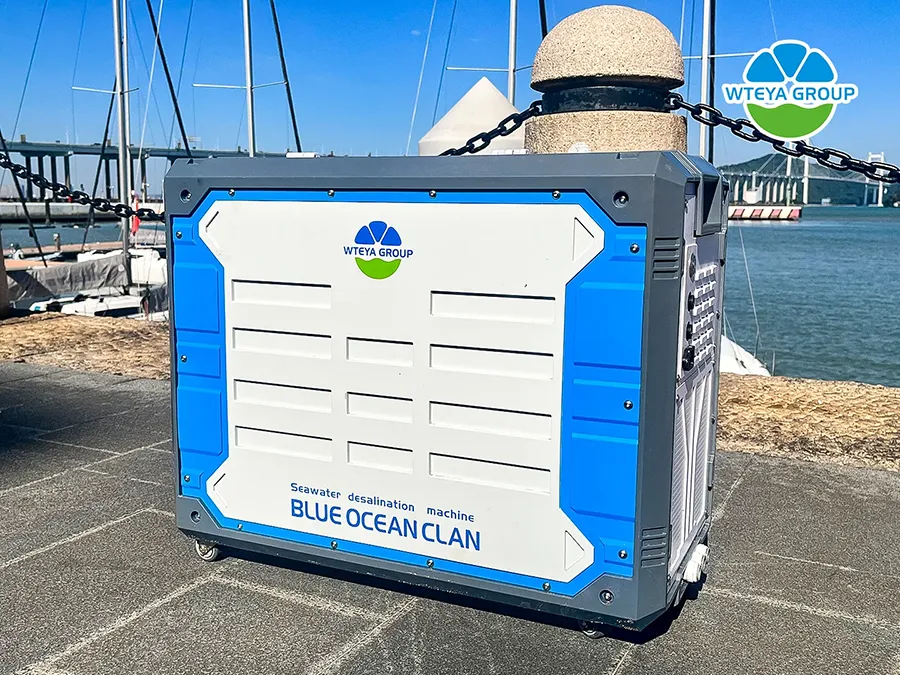
3. Installation space. A typical portable unit measures about 610 × 320 × 497 mm and weighs about 40 kg, so it fits a cabin, a deck, or an RV bay — but you must leave room to reach the filters, membrane, and UV lamp for servicing.
4. Budget. Price depends on the configuration you choose — power version, fittings, spare-part package, and any customization — so confirm the exact specification and current price with the manufacturer instead of comparing headline numbers alone.
Matching the Machine to Your Scenario
Fishing boats and yachts. Choose the 24V DC version for direct battery supply; 300 GPD is enough for a crew's daily drinking water.
Island homes and coastal villas. Choose the 220V mains version with an output of 1 t/day or more to cover a household or a small business.
Emergency and outdoor use. Choose the solar version (PV panels plus battery) so fresh water can be produced with no grid power at all.
Research, patrol and marine survey teams. Choose a reinforced model with corrosion-resistant materials and a wide voltage range for long deployments.
Checks Before You Order
Confirm the feed salinity. Standard seawater is TDS ≤ 35,000 ppm; higher-salinity or brackish sources need a tailored configuration.
Reserve maintenance space. Filters, RO membrane, and UV lamp all need periodic replacement, so keep clear access to the service side of the unit.
Ask about after-sales support. Confirm the warranty terms, spare-part availability, and local service coverage before you commit.
Related FAQs
How Much Water Does a Portable Seawater Desalination Machine Produce Per Day?
Is the Water Quality of Portable Seawater Desalination Good?
Is a Portable Seawater Desalination Machine Suitable for Fishing Boats?
How to Install a Portable Seawater Desalination Machine?
Is a Portable Seawater Desalination Machine Suitable for Yachts?
📲 WhatsApp: +86-1802 5185 143
📧 Email: sales@wteya.com
🌐 Website: www.wteyaa.com

Previous: Is a Portable Seawater Desalination Machine Suitable for Yachts?
Next: No More