







Are Handheld Seawater Desalination Devices Really Useful?
Are Handheld Seawater Desalination Devices Really Useful?
Yes — but only for the job they were designed for. A handheld (manual) seawater desalination device is a genuine piece of survival equipment: it needs no battery, weighs under a kilogram, and can turn seawater into drinkable water when nothing else is available. What it cannot do is supply a crew, a camp, or a household with water day after day. For emergency use it is useful; for regular supply it is the wrong tool, and an electric portable desalination machine is the correct choice.
What a Handheld Desalinator Actually Does
A manual desalinator uses a hand crank or a lever pump to pressurise seawater to roughly 55 to 80 bar, forcing it through a small reverse osmosis membrane. The membrane rejects the dissolved salt, and a few hundred millilitres to one or two litres of fresh water comes out for every hour of pumping. Everything else — the brine — is discharged back overboard.
That pressure has to come from a human arm, and this is the whole story of the device. A person can sustain perhaps 50 to 100 watts of pumping effort. An electric unit's high-pressure plunger pump delivers the same pressure continuously without fatigue, which is why the output gap between the two categories is measured in orders of magnitude rather than percentages.
The Honest Limits of Hand Power
Manufacturers quote output per hour of pumping, which is accurate but easy to misread. In practice a handheld unit delivers roughly 0.5 to 1.5 litres per hour of continuous effort, and the effort is tiring. A single person in a liferaft can produce enough to survive, which is exactly what the device is certified for. Three people trying to run a normal day on it will fail.
There are other practical limits worth knowing before buying. Manual units are sensitive to membrane fouling and need careful flushing with fresh water after every use, which is difficult when fresh water is the thing you lack. They are also intolerant of dirty or oily feed — the tiny membrane element clogs quickly. And because the pump seals are the wear part, a unit stored for years without use should be tested before it is relied on.
Where an Electric Portable Machine Wins
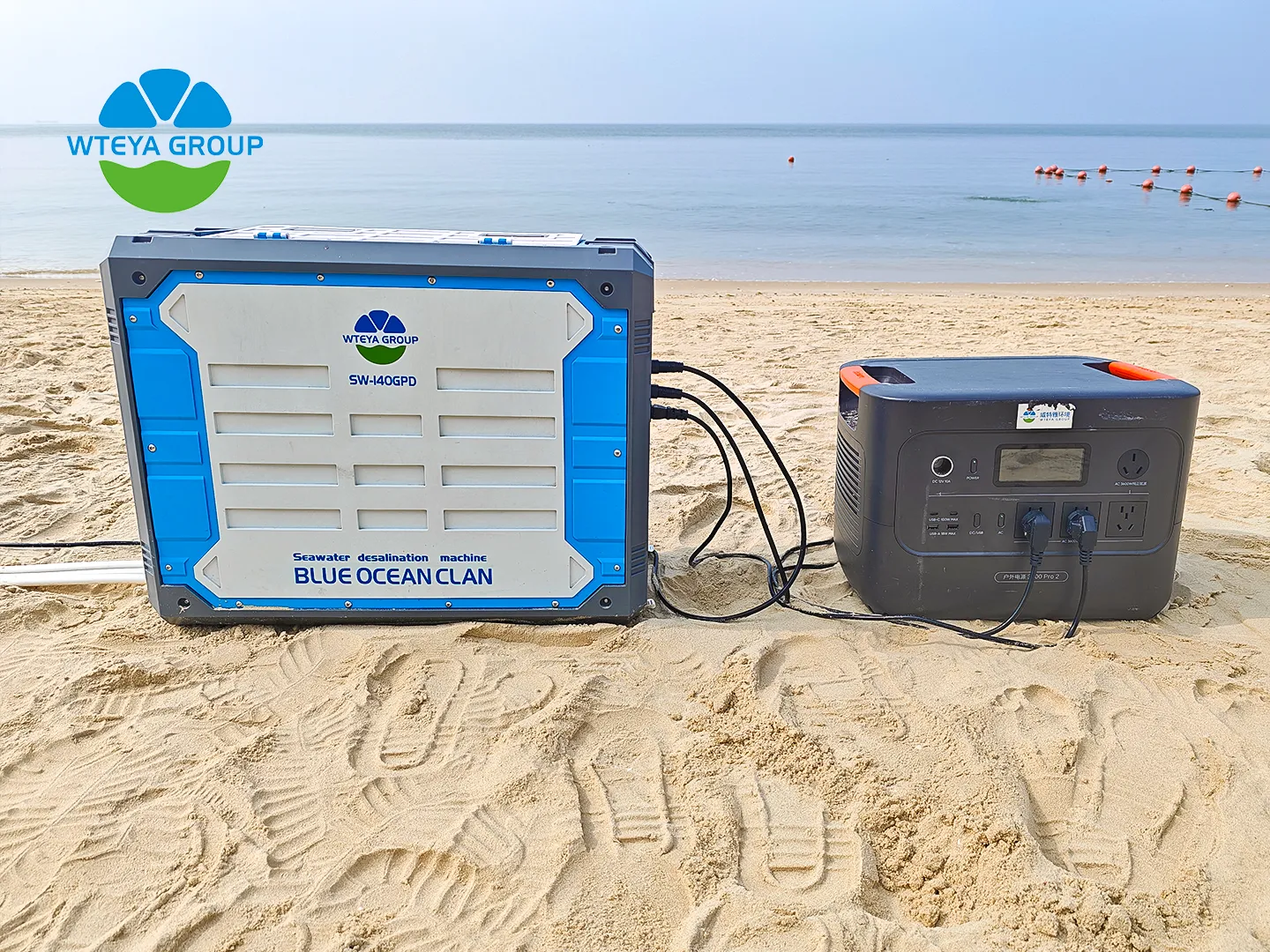
An electric portable desalination machine such as the SW-4021 is built for sustained supply rather than survival. Its high-pressure plunger pump holds a steady 100 bar, driving a full-size RO membrane at a continuous output of 300 GPD — about 1,200 litres per day, or 50 litres per hour. That is the daily drinking, cooking and washing requirement of a small fishing crew, a yacht, or an island camp.
The unit runs on 220V or 24V with a 1.35 kW installed power draw, so it can be fed from a generator, a battery bank, or a solar array. Salt rejection is above 99 percent, and the product water passes a 254 nm UV stage so it can be drunk directly. Compared with hand pumping, the same hour of operation produces roughly a hundred times more water.
Electric units also tolerate real-world feed better. The larger membrane area, pre-filtration stages and higher circulation flow let the system handle turbid coastal water that would destroy a handheld element, and cleaning is a routine procedure rather than a delicate one.
Matching the Device to the Scenario
The decision is simpler than the marketing suggests. Ask two questions: how many people need water, and for how long.
Liferaft, lifeboat, single-person survival kit, hiking emergency. A handheld unit is the right answer. It is light, needs no power, has no battery to fail, and its modest output matches a survival ration of two to three litres per person per day.
Fishing boat, yacht, coastal camp, remote site, disaster response team. An electric portable machine is the right answer. Once more than two or three people depend on the device, or once it must run for days rather than hours, hand pumping stops being feasible and the electric unit's output and water quality become decisive.
Both, in some cases. Vessels that already carry a 300 GPD machine often keep a handheld unit in the liferaft as a backup, because the electric unit depends on power and the liferaft may not have any. The two categories complement each other rather than compete.
What to Check Before Buying Either Type
For a handheld device, verify the certified output per hour, the membrane element type and replacement availability, and whether the pump seals are user-serviceable. A device you cannot service is a device you cannot rely on.
For an electric portable machine, check the rated output at realistic seawater temperature and salinity, the power supply options, the pre-filtration arrangement, and the membrane service interval. A unit rated at 300 GPD with warm seawater will produce less in cold water, so ask for the rated condition rather than the headline number. Also confirm the UV stage and the post-treatment, because desalinated water is low in minerals and slightly aggressive to metal plumbing.
Finally, treat both as equipment that needs a maintenance routine rather than a sealed appliance. Membranes foul, pre-filters clog, and seals age. A short flush after each use and a scheduled membrane check will extend service life far more than any specification on the brochure.
Related FAQs
What Determines the Price of a Portable Desalination Machine?
How to Choose a Portable Seawater Desalination Machine
How Long Does a Portable Seawater Desalination Machine Last?
Can a Portable Desalination Machine Be Used for Camping?
Portable Desalination Machine Maintenance Schedule and Tips
Is a Portable Seawater Desalination Machine Suitable for Fishing Boats?
📲 WhatsApp: +86-1802 5185 143
📧 Email: sales@wteya.com
🌐 Website: www.wteyaa.com

Previous: Portable Desalination Machine Maintenance Schedule and Tips
Next: No More