







Desalination Pretreatment: Why It Matters for RO Systems
Desalination Pretreatment: Why It Matters for RO Systems
Seawater looks clear, but it carries everything the ocean has picked up along the way: suspended solids, algae, organic matter, iron, and the calcium and magnesium ions that form scale. A reverse osmosis membrane is the most expensive component in any desalination system, and it is also the one most easily ruined. Pretreatment is what stands between raw seawater and that membrane, and it is the cheapest insurance a desalination project can buy.
This guide explains what desalination pretreatment has to remove, how the treatment train is built, the feedwater targets it must deliver, and how it protects both membrane life and operating cost on WTEYA systems, from portable water makers to containerized and plant-scale installations.
🌊 What Pretreatment Has to Remove
Raw seawater attacks RO membranes in several distinct ways, and each one needs its own barrier:
- Suspended solids and turbidity — sand, silt and clay that block the feed channels of the element.
- Algae and organic matter — plankton, seasonal blooms and their decay products, which form a biofilm on the membrane surface.
- Scale-forming hardness — calcium, magnesium, sulphate and carbonate that precipitate as recovery rises.
- Iron and manganese — dissolved metals that oxidise in the concentrate and foul the membrane.
- Free chlorine and oxidants — even brief exposure above 0.1 ppm permanently destroys the polyamide rejection layer.
- Oil and hydrocarbons — present in harbours, marinas and busy shipping lanes; they coat the membrane and are very hard to remove.
⚙️ The Pretreatment Train, Step by Step
A well-designed seawater desalination system arranges these barriers in sequence, each stage protecting the next:
- Intake screening — coarse screens, and where the site allows it a beach well or subsurface intake that already filters out the largest debris.
- Coagulation and clarification — dosing with settling or dissolved air flotation to strip algae and colloidal solids during periods of poor water quality.
- Multi-media filtration — graded sand and anthracite beds that bring turbidity down to about 1 NTU or less.
- Cartridge filtration — 10 µm and 5 µm elements as the final physical barrier immediately ahead of the high-pressure pump.
- Antiscalant dosing — a scale inhibitor that permits recovery of 40% to 50% without calcium sulphate or carbonate precipitation.
- Dechlorination — sodium metabisulphite dosing whenever chlorine has been used upstream.
The sequence is the same on compact and containerized systems; on a portable machine the intake screening and the 10 µm and 5 µm cartridges do the whole job in two small housings.
📊 Feedwater Targets Pretreatment Must Deliver
Pretreatment is judged on measured numbers at the RO inlet, not on how clear the water looks. These are the design targets WTEYA applies across its desalination range:
- Silt density index (SDI15): 5 or less, ideally below 3
- Turbidity: 1 NTU or less
- Free chlorine: below 0.1 ppm
- LSI: below 2.5, controlled by antiscalant dosing
- Feed pH: 4 to 9; feed temperature: 5 °C to 45 °C
- Feed TDS: up to 45,000 mg/L in standard seawater RO configuration
Held inside these limits, a seawater RO system keeps salt rejection above 99.5%, produces water below 200 ppm TDS, and consumes as little as 3 to 4 kWh per cubic metre when fitted with energy recovery.
💰 Why Pretreatment Pays for Itself
Membrane elements are rated for 2 to 5 years of service, but that rating is conditional on the feedwater targets above being met. Fouling and scaling announce themselves as lost performance long before the element fails: normalised permeate flow drops by 15%, differential pressure between feed and concentrate rises by 15%, or salt passage increases by 5%.
Each of those symptoms means more cleaning cycles, and every cleaning cycle costs chemicals, labour and downtime. Poor pretreatment also raises running cost directly, because the high-pressure pump must work harder against a fouled membrane, and that energy penalty repeats on every cubic metre produced. A pre-filter cartridge costs a small fraction of an RO element, and replacing it on schedule is far cheaper than cleaning, or eventually replacing, the membrane behind it.
🏝️ Pretreatment at Three Different Scales
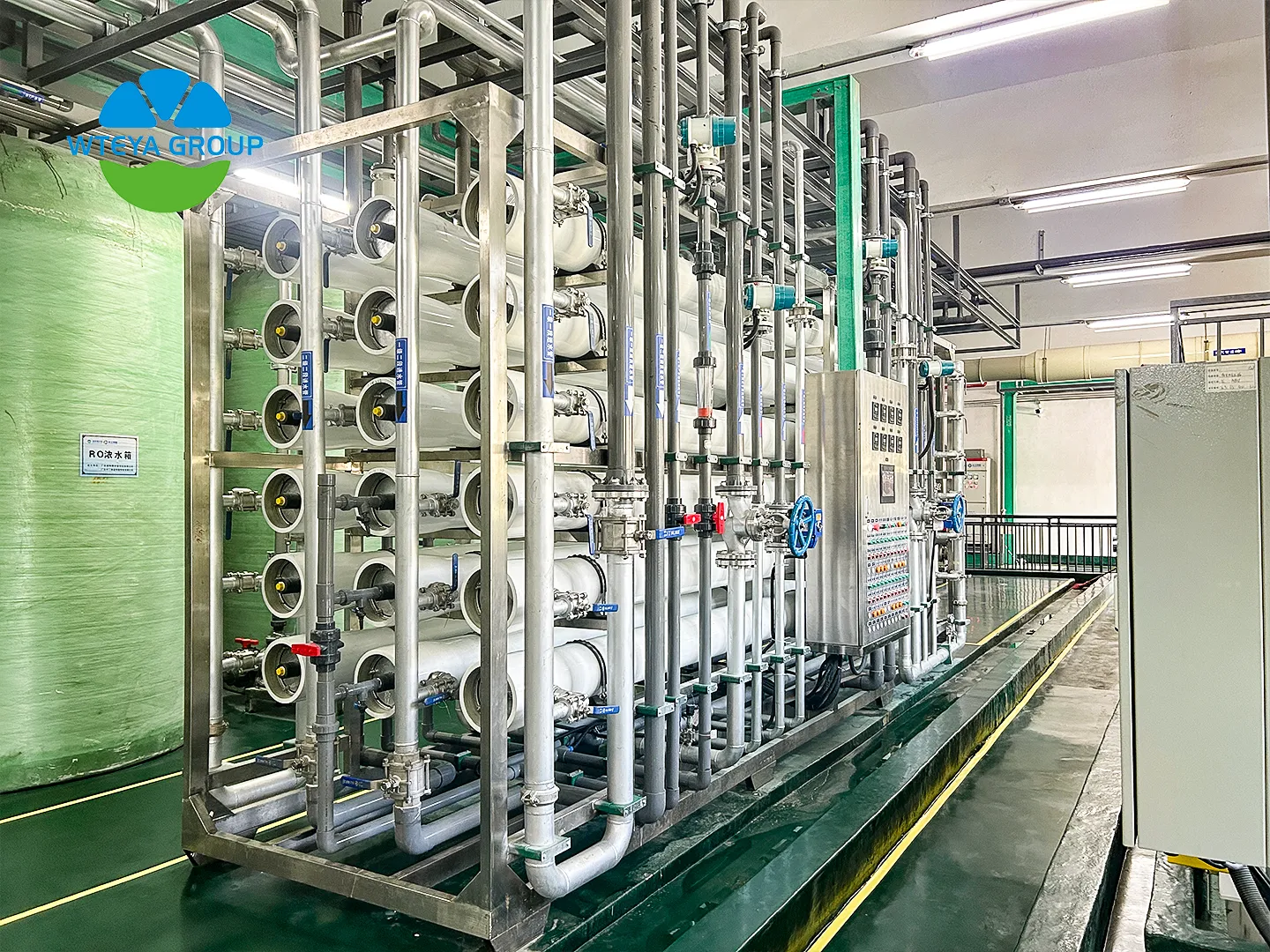
WTEYA builds desalination equipment at three scales, and the pretreatment scope grows with the plant. Portable machines carry integrated 10 µm and 5 µm cartridges and draw from a beach well, a storage tank or pre-settled seawater. Containerized plants of 5 m³/h and 10 m³/h include multi-media filtration, cartridge filtration and antiscalant dosing inside the container. Full seawater desalination plants add clarification for turbid or seasonally algal water before the same downstream train.
Because source water differs so much from one site to the next, whether it is high turbidity, heavy sediment, low temperature or high salinity, the pretreatment train is configured for the project rather than taken from a fixed specification sheet.
🏆 Why Choose WTEYA
WTEYA has nearly 20 years of experience in water treatment and desalination and has served more than 2,000 customers. Pretreatment is matched to the sea area and the season, and every unit is factory-tested before shipment, installed and commissioned by WTEYA engineers, then supported through operator training and life-cycle spare parts. For owners and dealers, that means the membrane is protected by design rather than by hope.
❓ Frequently Asked Questions
Is pretreatment necessary on a portable desalination machine? Yes. A portable machine carries its own pretreatment in the form of a 10 µm and a 5 µm cartridge ahead of the pump, plus an intake that must be kept clear of sand and weed. Those two cartridges are what allow the membrane to reach its rated 3,600 running hours.
How often do pretreatment filters need changing? The 5 µm element is normally replaced every 15 to 30 days of operation, while the 10 µm element is cleaned more often, every 5 to 60 hours, depending on how much suspended matter the seawater carries.
Can pretreatment be overdone? It can be misapplied. Excess coagulant or chlorine creates problems of its own on the membrane, and any chlorine that reaches the RO must be removed first. Pretreatment should be designed to hit the measured targets, not simply to add more stages.
🤝 Become a WTEYA Authorized Dealer
WTEYA is expanding its dealer network in coastal, island and marine markets, and pretreatment know-how is part of the package: we help partners size filtration, select membranes and configure systems for local sea conditions. Dealers receive exclusive territories, competitive factory pricing, product and service training, marketing material and spare-parts support.
Become a WTEYA authorized dealer — exclusive territories, competitive pricing, and full factory support. Contact us to discuss your region and request the dealer application pack.
📲 WhatsApp: +86-1800 2840 855
📧 Email: info@wteya.com
🌐 Website: www.wteyaa.com
Previous: Water Maker Maintenance: Extending RO Membrane Life
Next: No More