






Emergency Desalination: Rapid Water Deployment for Disaster Relief

Emergency Desalination: Rapid Water Deployment for Disaster Relief
When a hurricane, earthquake, or flood strikes, clean drinking water disappears in hours. Contaminated sources, broken pipelines, and overwhelmed supply chains leave survivors without their most basic need. Every minute without safe water raises the risk of waterborne disease outbreaks — a crisis within a crisis that aid organizations struggle to contain.
Relying on bottled water shipments means waiting days for logistics to catch up. Road damage, airport closures, and fuel shortages turn water delivery into a gamble. The math is brutal: an average adult needs 3 liters of drinking water daily, and a camp of 5,000 displaced people requires 15,000 liters every single day.
Why Traditional Disaster Water Supply Fails
The standard playbook — trucking in bottled water or setting up temporary storage tanks — collapses when infrastructure is destroyed. Bottled water costs $0.50 to $2.00 per liter in disaster zones, and a single truck carries only enough for 1,000 people for one day. Storage tanks need refilling, which depends on intact supply chains that often don't exist.
Portable water purification tablets and manual filters handle small volumes but cannot scale to refugee camp levels. Fuel-powered water treatment plants work — until fuel runs out or parts break with no replacement available.
Emergency Desalination: On-Site Fresh Water Within Hours
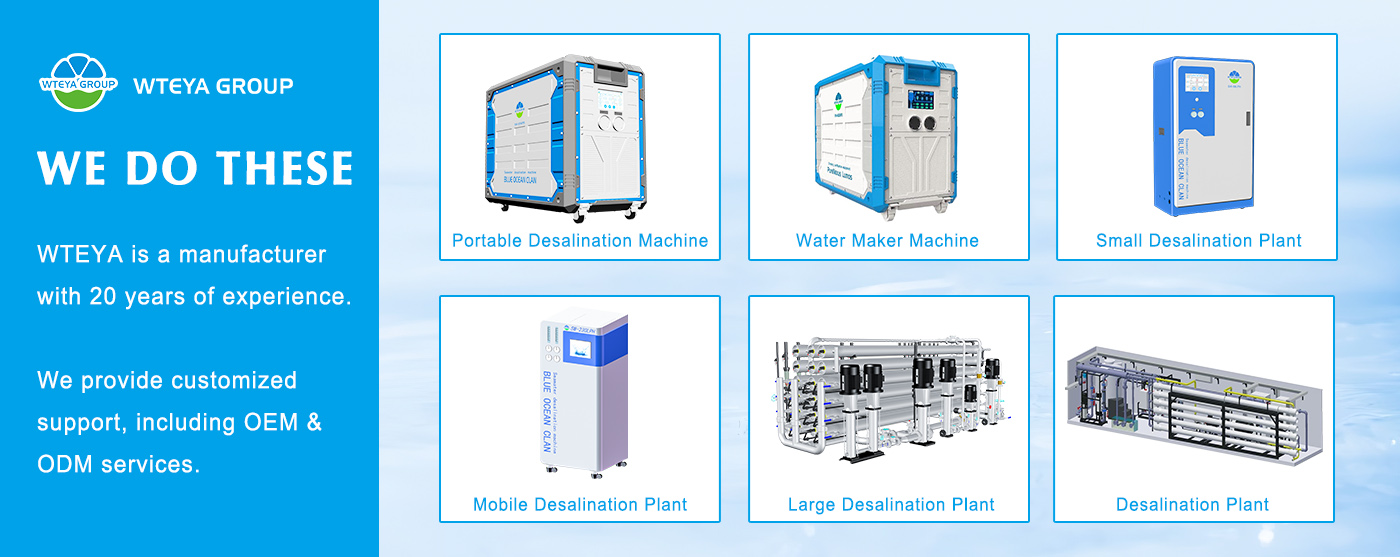
WTEYA emergency seawater desalination equipment changes the equation entirely. Instead of waiting for deliveries, response teams deploy a self-contained unit that converts seawater or brackish water directly into drinking water. Setup takes under two hours, and the system begins production immediately — no external power grid or water source needed.
Unlike traditional desalination plants that require permanent infrastructure, these rapid deployment units are skid-mounted or containerized for helicopter transport. One compact system produces 500 to 5,000 liters per day, enough for hundreds to thousands of survivors from a single source that never runs dry: the ocean.
Core Advantages of Rapid Deployment Systems
Immediate operational readiness. Pre-assembled and factory-tested, the system arrives on-site requiring only seawater intake and a power connection. A solar-compatible configuration on the WTEYA solar desalination platform eliminates generator dependency entirely for off-grid disaster zones.
Medical-grade output. Multi-stage filtration — including sub-1-micron pre-filters, high-pressure RO membranes, and UV sterilization — meets WHO drinking water standards. Output TDS consistently below 300 mg/L, safer than most bottled water.
Minimal logistics footprint. A 2,000 L/day unit occupies less than 2 square meters and weighs under 300 kg dry. Four personnel can offload and commission it without heavy equipment. Compare that to the fuel trucks, warehouse storage, and distribution fleet required for bottled water equivalent.
Where Emergency Desalination Proves Critical
Coastal and island communities are the most vulnerable. A cyclone can cut off an island's entire fresh water supply, yet the surrounding seawater remains a limitless resource. WTEYA containerized desalination systems serve as permanent standby assets in cyclone-prone regions, activated only when local water infrastructure fails.
Naval and coast guard vessels increasingly carry portable desalination machines as standard rescue equipment. During the 2023 Libya floods, maritime rescue crews used onboard water makers to supply coastal hospitals when municipal water lines were destroyed.
Field hospitals and mobile clinics depend on sterile water for surgery, dialysis, and sanitation. Bottled water logistics cannot guarantee the purity or volume needed for medical operations. An integrated water purification system with RO and UV stages ensures clinical-grade water at point of care.
Remote construction camps and offshore platforms facing supply chain disruptions also benefit from emergency backup desalination. When the nearest port is 500 km away and fresh water runs low, on-site seawater conversion prevents project shutdowns and crew evacuation.
Building Resilient Water Infrastructure
Disaster preparedness is shifting from stockpiling bottled water to deploying self-sufficient treatment capacity. Agencies are recognizing that rapid deployment desalination transforms response timelines from weeks to hours — and turns a logistical nightmare into a solvable engineering challenge.
The technology exists now. Lightweight, energy-efficient, and simple to operate, WTEYA emergency desalination units give humanitarian teams what they have always needed: the power to make fresh water anywhere, anytime, from the one source that covers 71% of the planet.
📲 WhatsApp: +86-1800 2840 855
📧 Email: sales@wteya.com
🌐 Website: www.wteyaa.com