






Containerized Desalination Systems: Turnkey Water for Island Communities
Containerized Desalination Systems: Turnkey Water for Island Communities
Fresh water is the single biggest challenge for island communities worldwide. Whether you manage a resort in the Maldives, operate a facility on a remote Pacific atoll, or supply water to a coastal village cut off from municipal infrastructure—reliable freshwater access determines everything from guest satisfaction to basic survival. Shipping water by barge is expensive, weather-dependent, and unsustainable at scale. Groundwater, where it exists, is often brackish or contaminated by seawater intrusion. Island communities need a solution that arrives ready to run, not a construction project that takes years.
The Water Challenge Facing Island Communities
Island water supply faces a unique set of constraints. Distance from mainland logistics drives up transport costs dramatically—a cubic meter of water that costs pennies on the mainland can cost ten times more delivered by tanker. Saltwater intrusion into freshwater lenses is accelerating as sea levels rise and coastal aquifers are overdrawn. Many islands lack the skilled labor, heavy equipment, and construction materials needed to build permanent treatment plants from scratch. The result is a persistent water deficit that holds back economic development, limits tourism potential, and degrades quality of life.
Conventional desalination plants are not the answer for most islands. They require civil works, concrete foundations, months of on-site assembly, and specialized operators. A resort that needs water by tourist season or a community facing an immediate crisis cannot wait for a construction timeline. The operational reality is clear: islands need rapid deployment, minimal site preparation, and systems that can be maintained with basic training.
Containerized Desalination: A Turnkey Solution
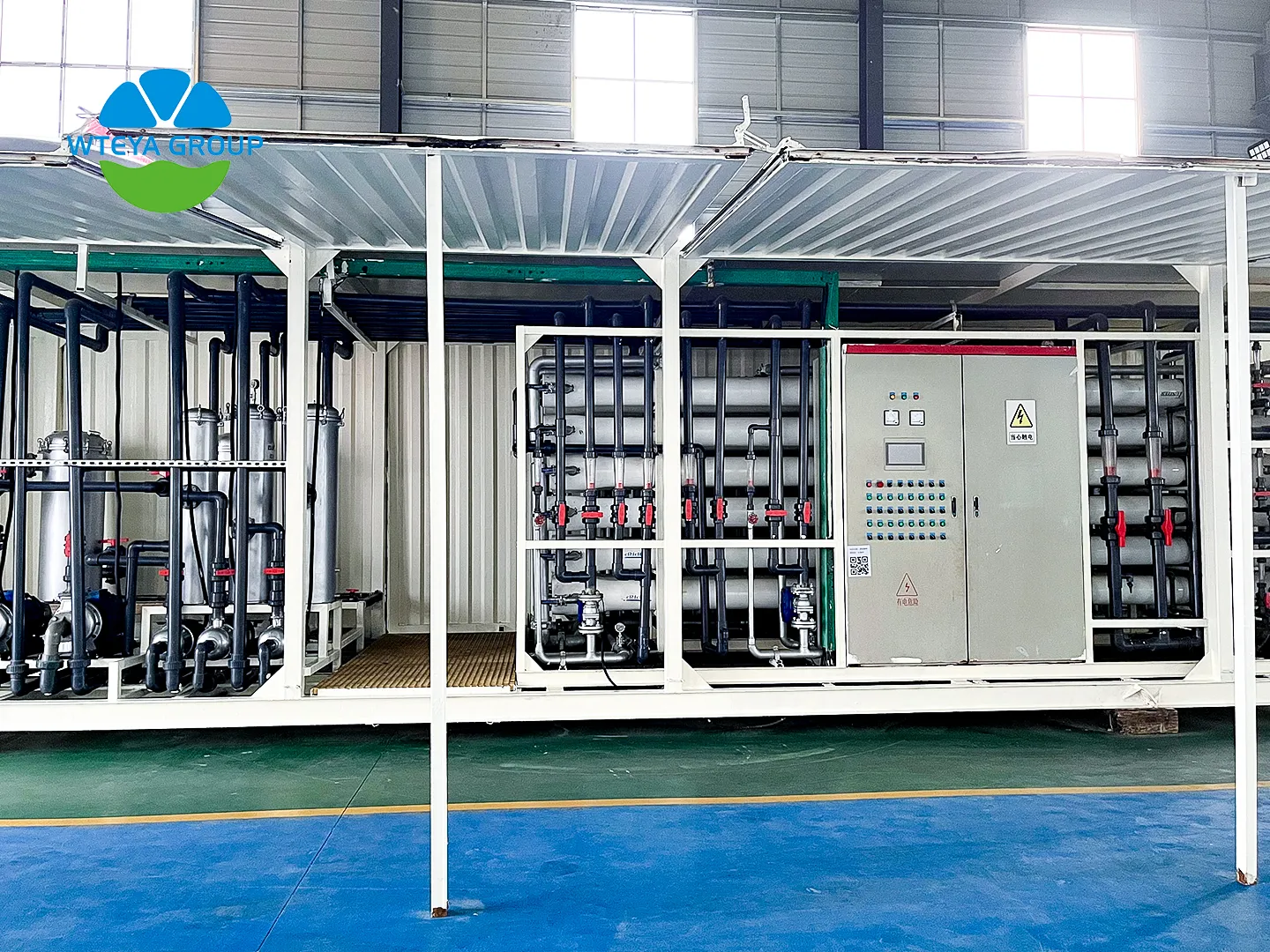
Containerized desalination systems change the equation entirely. Instead of building a plant on-site, the entire desalination system is pre-assembled, pre-tested, and pre-piped inside a standard shipping container at the factory. The container is then transported to the island by standard freight, lowered onto a prepared pad, connected to seawater intake and power, and commissioned in days—not months.
WTEYA container desalination systems integrate reverse osmosis membranes, high-pressure pumps, energy recovery devices, pre-treatment, and control automation into a single ISO container footprint. The system arrives as a plug-and-play unit. Power it on, open the seawater valve, and fresh water flows. This factory-integrated approach eliminates on-site construction risk, reduces installation costs by up to 60% compared to stick-built plants, and ensures consistent performance because every system is wet-tested before it leaves the factory.
Unlike traditional plants that demand permanent structures and civil engineering, a containerized unit sits on a simple concrete pad or compacted gravel base. If water demand grows, a second container can be added alongside the first—modular scaling without redesigning infrastructure. For island communities with limited land, this compact format preserves valuable real estate for housing, agriculture, or tourism facilities.
Key Advantages of Containerized Systems
Rapid deployment. A containerized desalination unit can go from delivery to producing water in as little as one week. For emergency response, seasonal resorts, or time-sensitive projects, this speed is a decisive advantage over conventional construction timelines that stretch into months or years.
Factory-tested reliability. Every WTEYA container system undergoes full-system wet testing with actual seawater before shipment. Piping leaks, membrane defects, pump cavitation, and control logic errors are caught and corrected at the factory—not discovered on a remote island where spare parts and technicians are days away. This pre-commissioning step virtually eliminates startup failures common in field-assembled plants.
Minimal on-site infrastructure. Containerized systems need only a seawater intake line, a brine discharge line, and an electrical connection. No building, no crane, no skilled welding or pipefitting crew. Island operators with basic mechanical aptitude can manage daily operations after a short training period, supported by remote monitoring that allows WTEYA engineers to diagnose issues from the factory.
Scalable capacity. Standard container units are available from 50 m³/day to over 1,000 m³/day. Multiple containers can operate in parallel, giving island communities the flexibility to start with what they need today and expand incrementally as population or tourism grows. This pay-as-you-grow approach avoids the overinvestment trap of oversized plants built for demand projections that may never materialize.
Ideal Applications
Containerized desalination fits a wide range of island water scenarios. Resort operators use container units to secure independent water supply, eliminating dependence on municipal systems or expensive water tanker deliveries that limit guest capacity. Remote island communities gain a permanent freshwater source that supports schools, clinics, and local businesses without requiring mainland infrastructure connections. Military and coast guard installations on distant outposts achieve water self-sufficiency with systems ruggedized for harsh maritime environments. Offshore platform operators replace crew-change water logistics with on-site production that cuts supply vessel trips. Construction and mining camps on islands with zero existing infrastructure use container units as temporary water plants that relocate when the project moves.
Containerized desalination represents a proven, practical path to water independence for island communities. It removes the barriers of construction cost, skilled labor, and long timelines that make conventional plants impractical for remote locations. By delivering a pre-engineered, factory-tested, ready-to-run system in a shipping container, it transforms water supply from a multi-year capital project into a near-immediate operational solution.
📲 WhatsApp: +86-1800 2840 855
📧 Email: sales@wteya.com
🌐 Website: www.wteyaa.com