






Brackish Water vs Seawater RO: Which System Fits Your Water Source?
Brackish Water vs Seawater RO: Which System Fits Your Water Source?
Not all water sources are created equal — and neither are RO systems. Choosing the wrong desalination unit for your feed water can mean wasted energy, fouled membranes, and water that never meets quality standards. Understanding the difference between brackish water and seawater RO is the first step to getting it right.
What Sets Brackish Water and Seawater Apart?
Brackish water typically has a TDS (total dissolved solids) range of 1,000–10,000 mg/L — found in estuaries, inland aquifers, and river deltas. Seawater runs far higher at 30,000–45,000 mg/L. That gap in salinity drives every design difference between the two RO systems: membrane type, operating pressure, recovery rate, and energy consumption.
Why Using the Wrong RO System Costs You More
Running a seawater RO unit on brackish feed water means you are pushing 55–70 bar of pressure when only 10–20 bar would suffice. The result? Excess energy bills, accelerated membrane wear, and a recovery rate far below what a brackish system would deliver. Conversely, feeding seawater into a low-pressure brackish RO unit will stall production and quickly destroy the membranes under osmotic stress.
Key Design Differences at a Glance
Operating Pressure: Brackish RO operates at 10–20 bar; seawater RO requires 55–70 bar.
Membrane Elements: Brackish membranes are optimized for low-pressure, high-recovery operation. Seawater membranes use thicker polyamide layers to withstand high salinity.
Recovery Rate: Brackish systems recover 65–80% of feed water; seawater systems manage 30–45%.
Energy Use: Seawater RO can consume 3–5× more energy per liter of product water than brackish RO.
When to Choose a Brackish Water RO System
If your feed water TDS is below 10,000 mg/L — such as well water near coastal areas, brackish inland aquifers, or partially saline rivers — a brackish water desalination system is the clear winner. It runs on less energy, produces more clean water per gallon of feed, and costs significantly less to operate and maintain. WTEYA brackish RO systems are engineered for 65–80% recovery, cutting both waste and running costs.
When You Need a Seawater RO System
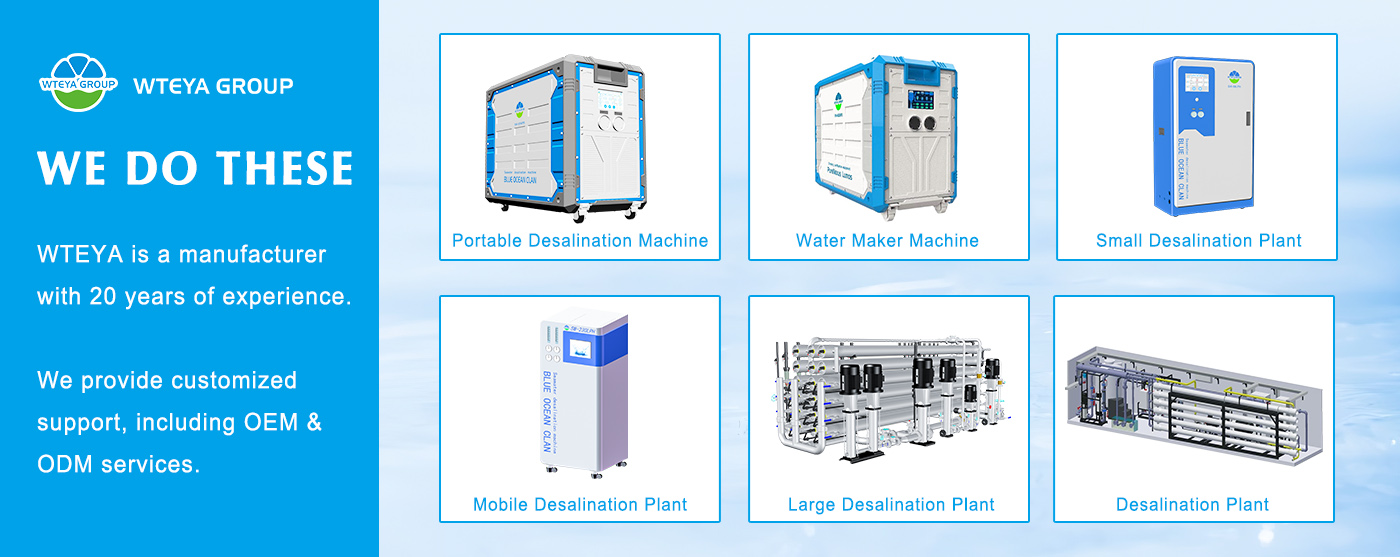
For open-ocean intake, island installations, or marine vessels drawing raw seawater, only a high-pressure seawater RO system will work. These units are built to handle 35,000+ mg/L TDS and deliver potable water reliably. WTEYA offers both portable desalination machines for boats and containerized seawater systems for larger shore-based demand.
Application Scenarios
Inland brackish wells: Brackish RO — low energy, high output.
Coastal resorts with brackish intake: Brackish RO — cost-efficient for moderate salinity.
Open-sea platforms: Seawater RO — the only option for full-strength seawater.
Yachts and fishing boats: Seawater RO — compact marine-grade units.
Estuary or river delta sites: Brackish RO — saline but not ocean-level.
Matching your RO system to your water source is not optional — it is the difference between a plant that runs efficiently for years and one that bleeds money from day one. WTEYA designs both brackish and seawater desalination systems, ensuring you get the right technology for your exact water conditions.
📲 WhatsApp: +86-1800 2840 855
📧 Email: sales@wteya.com
🌐 Website: www.wteyaa.com