






Brackish Water Treatment for Rural Communities: Reliable RO Solutions
Brackish Water Treatment for Rural Communities: Reliable RO Solutions
Across vast stretches of farmland and remote townships, the tap water carries a hidden burden: dissolved salts between 1,000 and 10,000 mg/L. For families in rural communities that rely on shallow wells, this brackish water tastes bitter, scales kettles, and over time contributes to hypertension in older residents. Children lose their appetite for school-day lunches cooked with mineral-heavy water, and small food processors near villages complain of corroded boilers. The real cost is not just taste — it is the long pipeline of bottled-water delivery trucks that never quite reaches every house.
Why Rural Brackish Water Is Hard to Fix
Standard chlorination kills bacteria but leaves the salts untouched. Reverse osmosis, long associated with seawater plants, was once ruled out for rural areas because of high pressure, energy draw, and skilled maintenance. Even the local water utility struggles with capital budgets, let alone the engineering support an RO membrane typically demands. Add seasonal load swings — harvest-time demand spikes, winter slowdowns — and most plug-and-play systems fail within a year.
A new generation of brackish water treatment systems addresses those realities directly. Running at lower feed pressure than seawater units, modern brackish RO systems cut energy use by 35 to 50 percent. Pre-engineered skids arrive on a single pallet, pre-plumbed and pre-tested, so a village technician can commission the unit in two days rather than two weeks. Automatic flushing cycles extend membrane life even when feedwater quality swings with the rainy season.
How Brackish RO Differs from Seawater RO
Both rely on the same semi-permeable membrane principle, but brackish water RO membranes are tuned for lower salinity and tolerate higher recovery rates. That means more product water per cubic meter of feed, less brine to manage, and a smaller concentrate disposal footprint — important where rural land is limited. Where seawater RO demands 60–70 bar, brackish RO commonly runs at 10–15 bar, drawing far less from village power lines.
For communities near brackish lakes, estuaries, or deep wells with sodium-chloride-sulfate blends, this difference translates directly into lower operating cost and simpler infrastructure. WTEYA brackish water treatment systems pair the membrane with an anti-scalant dosing system and a clean-in-place loop, keeping recovery rates stable across seasonal changes.
Key Benefits for Rural Operators
- Lower energy bill: 10–15 bar operating pressure halves electricity draw compared to seawater RO; useful when diesel generators run during grid outages.
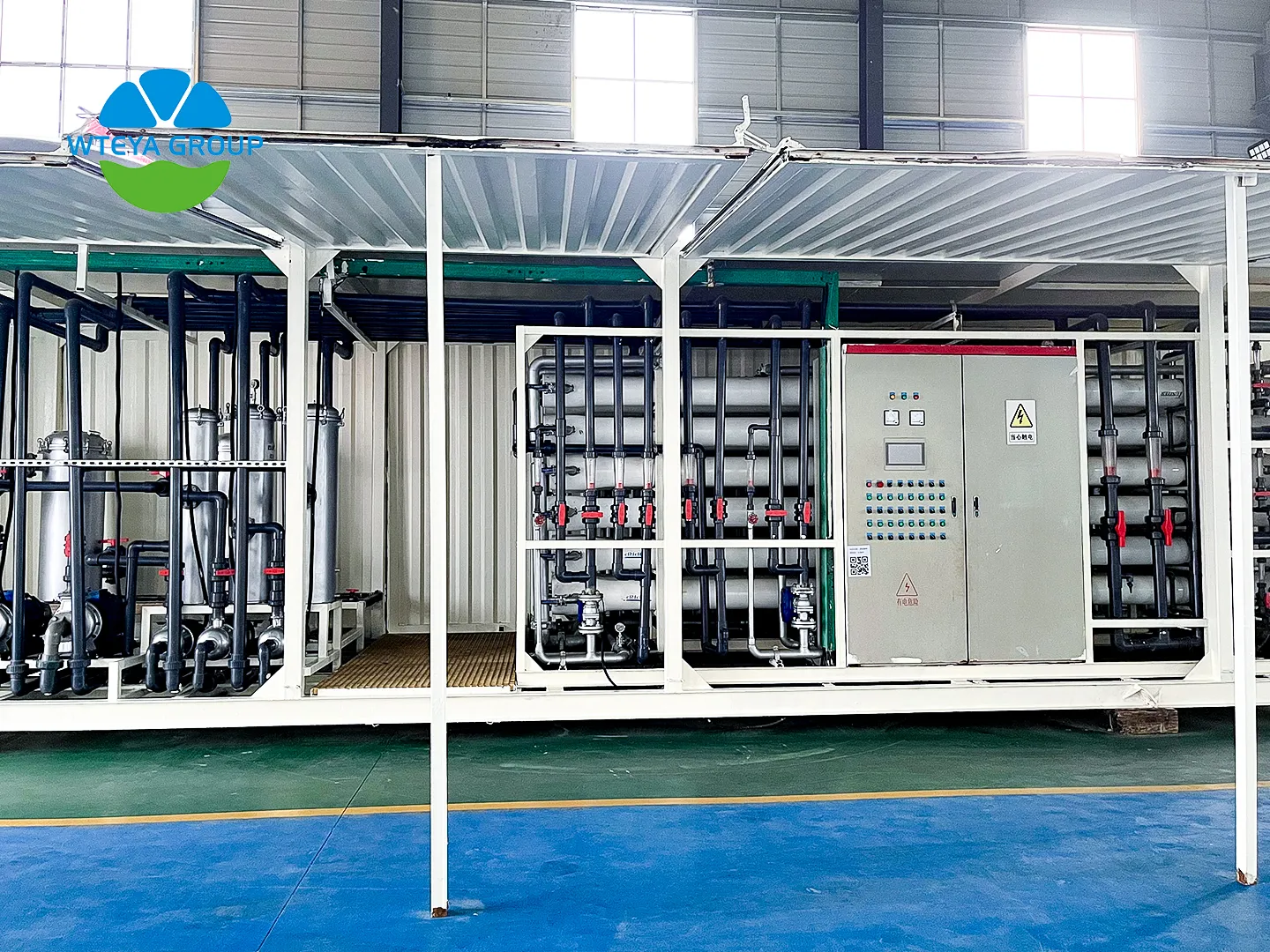
- Compact skid footprint: Pre-assembled brackish water treatment units fit on a single concrete pad next to a wellhead; no on-site fabrication needed.
- Smart automation: PLC-controlled flushing and recovery trim adjust to feedwater quality without an on-site chemist.
- Long membrane life: Anti-scalant dosing and scheduled CIP cycles routinely deliver five to seven years of membrane service in rural settings.
- Modular capacity: Standard 5,000 L/day units can be paralleled to grow with community demand without replacing the original skid.
Real-World Application Scenarios
Villages along the lower Mekong delta use brackish water RO units fed from shallow estuarine wells, producing 5 m³/h of potable water for schools and clinics. A township in inland Australia taps brackish groundwater with TDS around 4,200 mg/L — a unit running 12 hours per day serves 1,200 residents at a fraction of the cost of trucking in bottled water. Smallholder farming cooperatives in coastal North Africa treat brackish well water for drip irrigation, where controlled salinity improves yield on date palms and forage crops.
In each case, the common thread is reliability under non-ideal conditions: variable power, intermittent operator training, and feedwater that shifts with the weather. A robust brackish water treatment system is engineered for exactly these demands, not for the textbook seawater plant most engineers first learn about.
For distributed rural deployments, explore the WTEYA brackish water desalination system lineup on the brackish RO product page. Communities pairing RO with low-pressure feedstock also benefit from the compact 4040 RO system for small-clinic or school installations.
📲 WhatsApp: +86-1802 5185 143
📧 Email: sales@wteya.com
🌐 Website: www.wteyaa.com