







Generator Power for Portable Desalination: Sizing Guide
A portable desalination unit is only as reliable as the power behind it. Where the grid is missing — a quay, a field camp, a remote island — a generator usually fills the gap. But sizing that generator from the nameplate kilowatts alone is the fastest route to nuisance trips, burnt contacts and shortened pump life. This guide walks through the real electrical profile of a portable seawater desalination machine and shows how to choose a generator, battery bank or solar array that keeps fresh water flowing.
⚡ What the Unit Actually Draws
Take the SW-4021-300GPD as the reference package. It produces 300 GPD (1,200 LPD, 50 LPH) and contains two motors: a 0.15 kW feed pump moving 2,000 LPH at 20 m head, and a 1.1 kW high-pressure plunger pump delivering 360 LPH at 100 bar. Total installed power is 1.35 kW, supplied as single-phase 220–240 V or 24 V DC.
At 230 V and a power factor near 0.8, the steady running current is only about 6 A. On paper a 2 kW generator looks generous. In practice the pump, not the nameplate, decides whether the set starts.
🔧 Size on Starting Current, Not Nameplate kW
A directly started induction motor pulls 5 to 7 times its rated current for 0.2 to 0.5 seconds. For the 1.1 kW high-pressure pump that is a momentary demand of roughly 5.5–7.7 kW, and it arrives while the feed pump is already running.
The practical rule is to take the continuous load, add the motor-start surge, and then look at the generator’s peak rating — remembering that most small sets quote peak power for only 5 to 10 seconds. A 3.5–4 kVA class set with at least 2:1 motor-start capability covers a 1.35 kW unit comfortably; a 2 kVA suitcase generator may start it on a warm day and then trip on cold seawater, when higher viscosity pushes discharge pressure up.
Two derating factors are routinely forgotten. Output falls about 3% per 500 m above 1,000 m altitude and about 1% per 5 °C above 40 °C ambient. A set chosen at sea level in winter can be marginal at 1,500 m in summer.
🛠 Inverter or Conventional Generator?
An inverter generator with total harmonic distortion below 3% is the better match. It holds voltage and frequency steady for the UV ballast and the controller, runs quieter and throttles down when the pump is between cycles. A conventional AVR set is acceptable if distortion stays under 5% and voltage holds within ±5%. Modified sine wave inverters should be avoided entirely.
Check three plate details before buying: frequency must match the pump motor (50 or 60 Hz), voltage must sit inside the 220–240 V window, and fuel burn should be realistic — a petrol set typically uses 0.4–0.5 L per kWh at half load.
🔋 Battery and Solar Alternatives
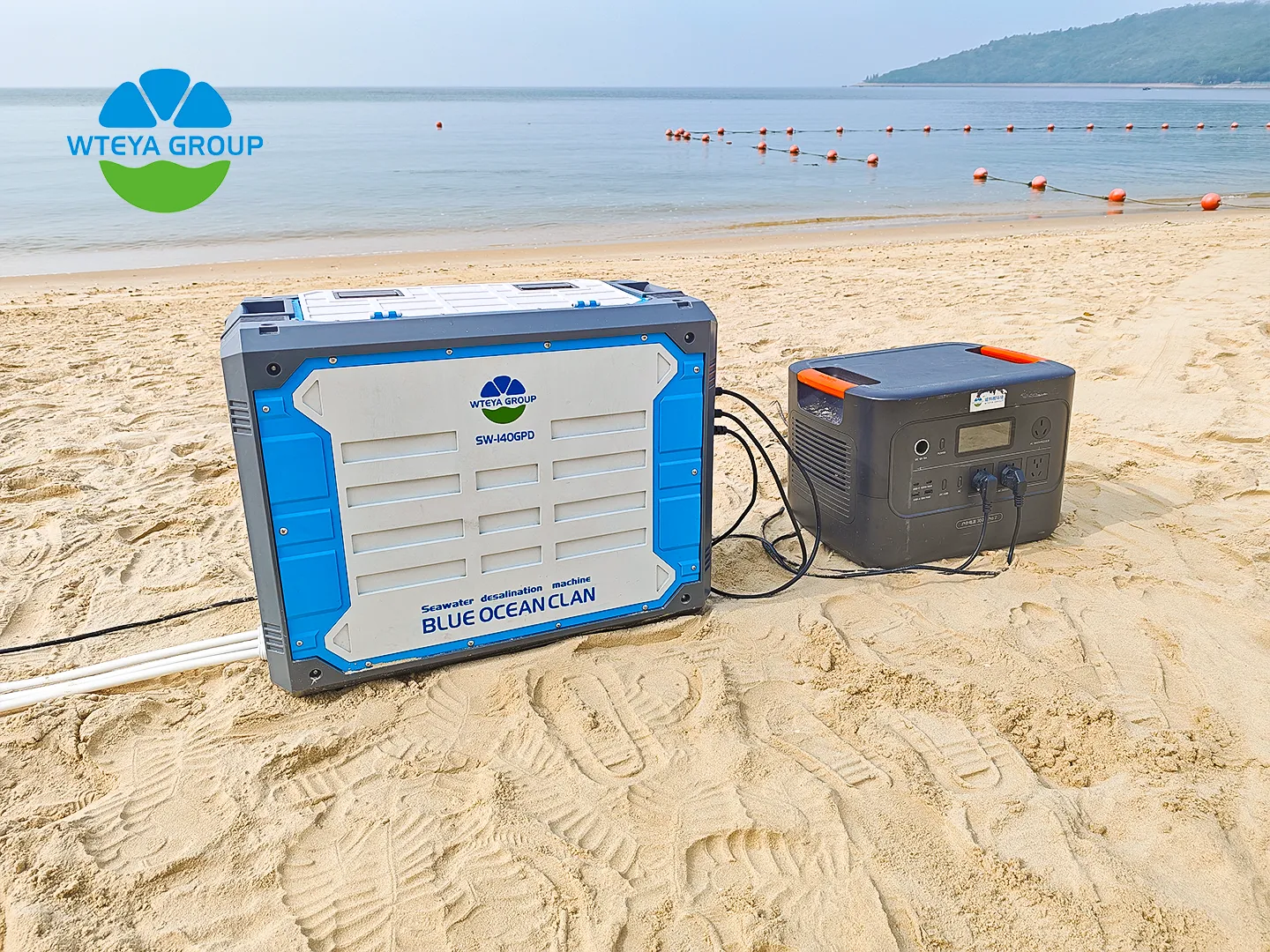
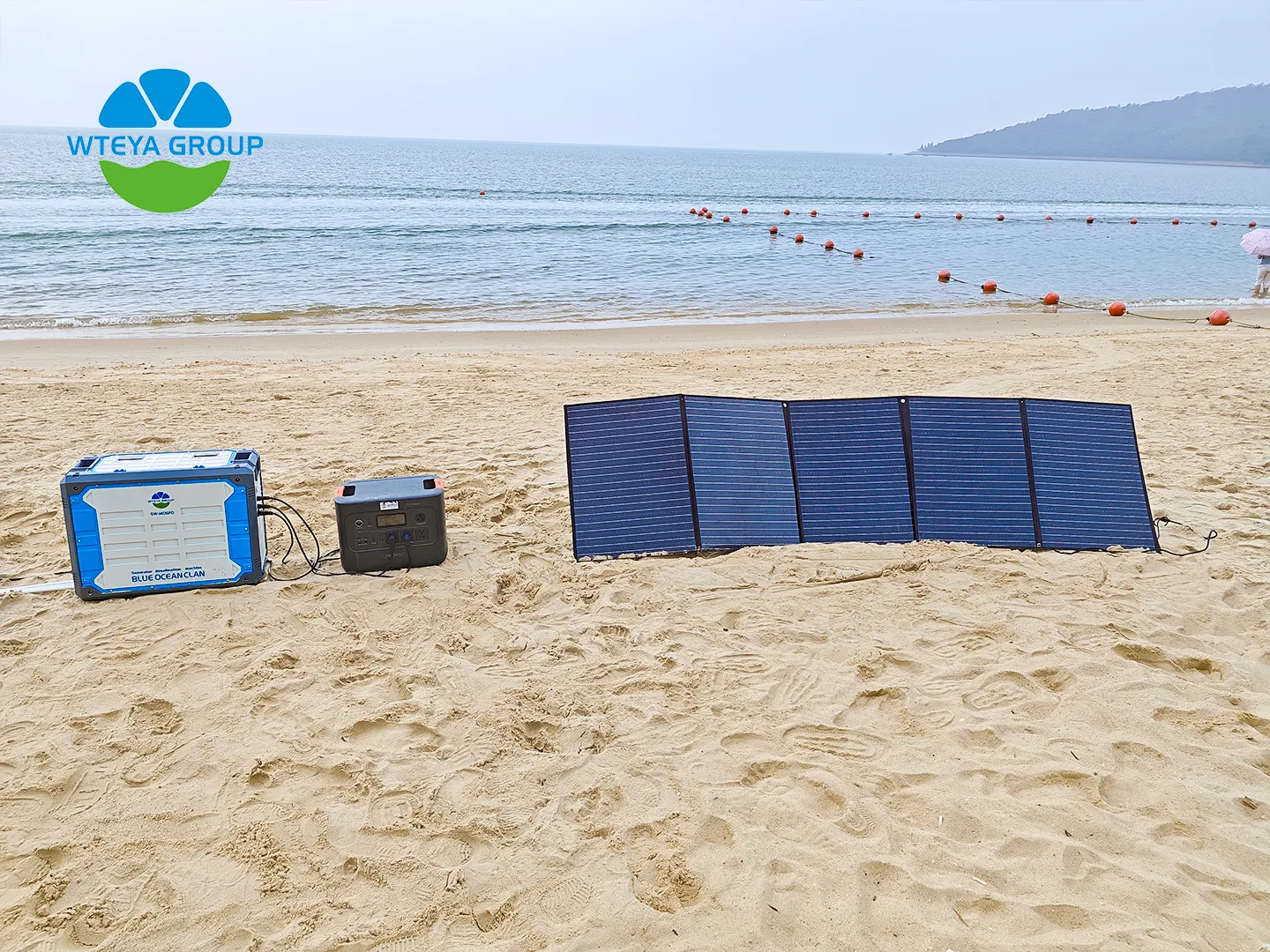
The same unit accepts a 24 V DC input, which opens two quieter options. A 24 V 100 Ah LiFePO4 pack stores about 2.56 kWh; at 80% usable capacity that is roughly 1.4 hours of running, while a 200 Ah pack stretches to about 3 hours. For daily duty, pair a 24 V bank with an MPPT charger and a 1.5–2 kWp array: in a location with 4–5 peak sun hours the array yields 6–9 kWh per day, enough for a five-hour pumping window that consumes about 6.75 kWh.
⚠ Five Mistakes That Cost Pump Life
1. Buying to the running load only. The start surge, not the 1.35 kW figure, is what trips a small set.
2. Long, thin extension leads. Keep leads under 10 m at 2.5 mm² and hold voltage drop below 3%; a coiled 1.5 mm² cable will brown out the pump.
3. No earthing or RCBO. Bond the generator neutral to earth and use a 30 mA residual current device, especially on a wet quay.
4. Exhaust near the intake. Carbon monoxide and salt-laden air both shorten engine and membrane life; keep 3 m of clear space and point the exhaust downwind.
5. Stale fuel and dry running. Petrol blended with ethanol should not sit in the tank beyond 30 days, and the feed pump must never run dry after the seawater line is lifted.
Finally, never back-feed a building circuit from a portable set without a proper transfer switch.
🏆 Why Choose WTEYA
WTEYA has spent nearly two decades building evaporation and membrane water systems, with more than 2,000 customers, 42 branches and a 30,000 m² manufacturing base in Jingshan. Every portable unit is pressure-tested before dispatch, arrives plug-and-play at 610×320×497 mm and 40 kg, and can be specified with solar-powered desalination or 24 V DC input for sites without a grid. For disaster response, the emergency seawater desalination configuration ships with the same pump set and a simplified connection panel.
❓ Frequently Asked Questions
Can a 2 kW generator run a portable desalination unit?
It may start a 1.35 kW unit in warm conditions, but there is no margin for the 5.5–7.7 kW start surge. A 3.5–4 kVA set with 2:1 motor-start capability is the safer choice.
What total harmonic distortion is acceptable?
Keep it below 5%; inverter generators below 3% are preferred because the UV ballast and controller are sensitive to waveform quality.
Can the unit run directly from a 24 V battery bank?
Yes. The SW-4021 accepts 24 V DC, and a 200 Ah LiFePO4 bank gives roughly three hours of continuous production.
🤝 Become a WTEYA Authorized Dealer
WTEYA is expanding its dealer network for portable and containerized desalination equipment. Partners receive exclusive territories, competitive factory pricing, technical training and full after-sales support — no prior water-treatment experience required.
Send your company profile and target region to start the application, or contact our export team directly.
📱 WhatsApp: +86-1802 5185 143
✉ Email: sales@wteya.com
🌐 Website: www.wteyaa.com
Previous: Winterizing a Portable Desalination Unit: Storage Guide
Next: No More